
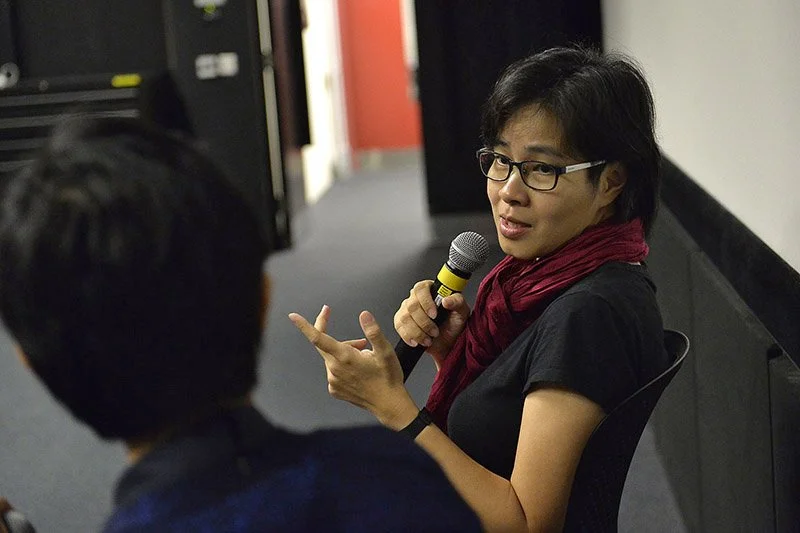
Tan Pin Pin (陈彬彬)is a leading Singapore filmmaker and artist whose practice spans film, photography, and installation. Her award-winning work investigates the construction of memory, history and national identity. Her works challenge conventional narratives and forms as well as modes of distribution.
Tan is widely recognised for her groundbreaking documentary features about Singapore, including Singapore GaGa (2005), Invisible City (2007), To Singapore, with Love (2013) and IN TIME TO COME (2017). Her parallel body of installations, such as 80km/h (2004), 9th August (2006), walk walk (2023) and On a Clear Day You Can See Forever (2025) extends these inquiries into spatial and archival dimensions.
Her films have been presented at major international festivals, including the Berlinale, Busan IFF, Hot Docs, SXSW, Viennale, and Vision du Réel. Her work has also exhibited in significant art contexts, including the Singapore Biennale, Thailand Biennale, Jakarta Biennale, and at institutions such as M+ (Hong Kong), MOMA (New York), TFAM (Taipei), Para-Site (Hong Kong) and House of World Cultures (Berlin). Mid-career retrospectives of her work have been held at Montreal International Documentary Festival (RIDM), DOK Leipzig, Flaherty Seminar and Liberation DocFest (Bangladesh).
Tan has served on the boards of the National Archives of Singapore, the Singapore International Film Festival, and The Substation, Centre for the Arts. She is a founding member of filmcommunitysg, an advocacy group for Singapore independent filmmakers. Her works are collected by the Singapore Art Museum and are in university libraries around the world.
Trained as a lawyer, Pin Pin started her career in the arts as a photographer. She produced a slide show, Another China (1992), about her sojourn to China. In 1993, she mounted a solo photography exhibition, Friends, Family and Strangers, a long form series. When video cameras became more affordable, she made the leap to the moving image after watching Taiwanese auteur Hou Hsiao Hsien’s City of Sadness. Inspired, she made her first film, Moving House (1996) using borrowed cameras. It is about the exhumation of her great-grandparent’s graves and their remains's subsequent move to a columbarium. The film got her her first film job as an assistant director for the police drama, Triple Nine, and latterly, a scholarship to study film at Northwestern University, USA. Her MFA graduation film won a Student Academy Award.
Upon her return to Singapore, in between TV jobs, she made Singapore GaGa (2005) a film about Singapore’s soundscape. It was described as “One of the best films about Singapore” by the Straits Times. It became the first Singapore documentary to have an 8-week sold-out theatrical run. For her second feature, Invisible City, the citation for the award from Cinema du Réel for Invisible City (2007), read “A witty, intellectually challenging essay on history and memory as tools of civil resistance”. Her short film Pineapple Town (2015), together with six other short film in the 7 Letters omnibus, was Singapore’s entry to the Oscars Meanwhile, To Singapore, with Love (2013), a film about Singapore political exiles was banned by Singapore’s censors for undermining National Security. IN TIME TO COME (2017), her next film, is an immersive film about Singapore rituals like fire drills and mosquito fogging sessions.
In parallel with filmmaking, she conceived a well-received two-channel rear projection installation, On a Clear Day You Can See Forever (2025) for the Singapore Biennale. walk walk (2023) about the politics behind walking is a public art installation commissioned by Singapore Art Museum on display until 2027 at the Kampong Bahru Bus Terminal.
To support the next generation of documentary producers, Pin Pin was the executive producer of Unteachable (2019). She has mentored at development programmes like the Yamagata Documentary Dojo (3 seasons), Japan, and Docs by the Sea, Indonesia (two seasons) and DMZ Docs. She has been on juries of Taiwan IDF, Dok Leipzig, Cinemanila, Jiffest and Busan amongst others as well as moderated at panels, given key notes. Pin Pin has an MFA from Northwestern University and an MA, Jurisprudence, from Oxford University.
As of May 2026, most of her films are available on Vimeo on Demand. 7 Letters can be caught on meWatch (Singapore), Singapore GaGa and IN TIME TO COMEare available on Netflix, SE Asia.
Writing by Pin Pin
“The Mother of Invention: Reflections on Technology, Distribution, Community and Connection.” In Routledge Handbook of Southeast Asian Cinemas. Edited By Alicia Izharuddin, Patrick F. Campos, 2026.
"Singapore GaGa Tours Singapore." In Southeast Asian Independent Cinema, edited by Tilman Baumgärtel, 131–40. Hong Kong University Press, 2012.
-
Khoo, Olivia. “Infrastructure and Mobility in Singapore: Tan Pin Pin’s walk walk.” In Routledge Handbook of Southeast Asian Cinemas. Edited By Alicia Izharuddin, Patrick F. Campos, 2026.
Yuan, Cheng Nien. “Living the Norm Way.” In The Storytelling State: Performing Lives in Singapore, 53–85. University of Hawai’i Press, 2025.
Siddique, Sophia. “Slippers Outside the Door: An Annotated Interview with Tan Pin Pin.” In The Routledge Companion to Asian Cinemas, 1st Edition, edited by Zhen Zhang, Sangjoon Lee, Debashree Mukherjee, and Intan Paramaditha. Routledge, 2024.
Fischer, Michael M. J. “Oiled Hinges: Sounds and Silences in Documentary Films of Social Change.” In At the Pivot of East and West: Ethnographic, Literary, and Filmic Arts, 47–75. Duke University Press, 2023.
Stein, Erica. “Telling One Another’s Stories: The City Symphony and Cine-Genre Narrative.”New Review of Film and Television Studies 20, no. 1 (2022): 25–36.
Liow, Xin Li. “Feminist Documentaries in Singapore.”Singapore Unbound, November 5, 2021.
Gao, Na. “失语·重构·突围 —— —新世纪以来的新加坡电影的记忆话语.” 华文文学, no. 4 (August 2021): 100–106.
Khoo, Olivia. “On the Banning of a Film: Tan Pin Pin's To Singapore, with Love.” Chapter. In Hard State, Soft City of Singapore, edited by Mike Douglass and Simone Shu-Yeng Chung, 69–92. Amsterdam University Press, 2020.
Leow, Joanne. “Circumventing the Archive: The Art of Charlie Chan Hock Chye and To Singapore, with Love.”Verge: Studies in Global Asias 6, no.1 (Spring 2020): 58-67.
Sim, Gerald. “Reorienting Film History Spatially.” In Postcolonial Hangups in Southeast Asian Cinema, edited by Gerald Sim, 97-139. Amsterdam: Amsterdam University Press, 2020.
"I, Lo-fen. “Virtual Epistle: Text and Image of the Film 7 Letters in Celebration of Singapore’s Golden Jubilee.”The Journal of Global Cultural Contents 41 (December 2019): 157–71.
Lim, Edna. “SINGAPORE CINEMA IN SINGAPORE.” In Celluloid Singapore: Cinema, Performance and the National, 165–85. Edinburgh University Press, 2018.
Lim, Lorraine. “Between Control and Disruption: News Media and Cultural Flows in Singapore and Hong Kong, China.” In Asian Cultural Flows: Cultural Policies, Creative Industries, and Media Consumers, edited by Nobuko Kawashima and Hye-Kyung Lee. Springer, 2018.
Watson, Jini Kim. “The Wrong Side of History: Anachronism and Authoritarianism.” In The Postcolonial Contemporary: Political Imaginaries for the Global Present, edited by Jini Kim Watson and Gary Wilder, 1st ed., 259–80. Fordham University Press, 2018.
Hsu, Fang-Tze. “Muted Speech, Apa Khabar Orang Kampung, and To Singapore, with Love.”Journal of the Malaysian Branch of the Royal Asiatic Society 90, no. 1 (2017): 113-126.
Irawanto, Budi. “Exploring the Terrains of Indonesian Cultural Policy: Learning from Singapore’s and Malaysia’s Experiences.” JSP: Jurnal Ilmu Sosial Dan Ilmu Politik 21, no. 1 (2017): 28–40.
Jimenez, Veronica. “What Fate Forbids: Reading Precarity in 21st-Century Texts.”Doctoral Theses (2009-), University of Toronto (Canada), 2017.
Koh, Jee Leong. “The Persistence of Memory.”Singapore Unbound, June 21, 2017.
Harvey, Sophia Siddique. “Sensuous Citizenship in Contemporary Singapore Cinema: A Case Study of Singapore GaGa (Tan Pin Pin, 2005).” In Singapore Cinema: New Perspectives, 1st Edition, edited by Kai Khiun Liew and Stephen Teo. Routledge, 2016.
Watson, Jini Kim. “Aspirational City: Desiring Singapore and the Films of Tan Pin Pin.”Interventions 18, no. 4 (July 2016): 543-558.
Chee, Lilian. “Chasing Inuka: Rambling Around Singapore through Tan Pin Pin’s Films.” In Asian Cinema and the Use of Space, edited by Lilian Chee and Edna Lim, 59-76. Abingdon, Oxfordshire: Routledge, 2015.
Leow, Ching and Joanne Chuang. “Counter-Cartographies: Literary Wayfinding in Transnational Cities.”Doctoral Theses (2009-), University of Toronto (Canada), 2015.
Khoo, Olivia. “Singapore, Sinophone, Nationalism: Sounds of Language in the Films of Tan Pin Pin.” In Sinophone Cinemas, edited by Audrey Yue and Olivia Khoo, 77-97. Palgrave Macmillan, London 2014.
Khoo, Olivia. “The Minor Transnationalism of Queer Asian Cinema: Female Authorship and the Short Film Format.” Camera Obscura 29, no. 1 (2014): 33–57.
Leow, Joanne. “Echoing the City: Notes on Re-Watching Tan Pin Pin’s Singapore GaGa.”ISSUE, no. 2 (2013): 41–50.
Tan, Kenneth Paul. “Alternative Vision in Neoliberal Singapore: Memories, Places, and Voices in the Films of Tan Pin Pin.” In Film in Contemporary Southeast Asia: Cultural Interpretation and Social Intervention, 1st Edition, edited by David C. L. Lim and Hiroyuki Yamamoto. Routledge, 2012.
Tan, Kenneth Paul. “Violence and the Supernatural in Singapore Cinema.”New Cinemas: Journal of Contemporary Film 8, no. 3 (2011): 213–23.
Leow, Joanne. “The Future of Nostalgia: Reclaiming Memory in Tan Pin Pin’s Invisible City and Alfian Sa’at’s A History of Amnesia.” The Journal of Commonwealth Literature 45, no. 1 (March 2010): 115–30.
Loh, Kah Seng, and Kai Khiun Liew, eds. “Film and the Making and Keeping of Singapore History and Memory: A Dialogue with Martyn See and Tan Pin Pin.” In The Makers and Keepers of Singapore History. Ethos Books, 2010.
-
2025
"Singapore Biennale 2025, Orchard edition: See five artworks at strata malls and old Raffles Girls’," Shawn Hoo, The Straits Times, 29 October, 2025."Tan Pin Pin, Wregas Bhanuteja secure grants from Purin Pictures fund," Wong, Silvia, ScreenDaily, 01 May, 2025.
2024
"BookTalk: Film-maker Tan Pin Pin finds succour in books," Ong, Sor Fern, The Straits Times, 10 August, 2024."Singaporean director Tan Pin Pin on her new documentary walk walk, and 30 years of capturing the Lion City on film," McCarty, Stephen, South China Morning Post, 26 February, 2024.
2023
"The Everyday Museum 'walk walk (Singapore Deviation version)' by Tan Pin Pin," Singapore Art Museum, YouTube, 05 October, 2023."Singaporean filmmaker Tan Pin Pin discusses collective memory and erasure of history," Jeyaretnam, Miranda, Yale Daily News, 11 April, 2023.
"Love in Exile: a Cinematic Pilgrimage to Watch Tan Pin Pin’s Censored To Singapore, with Love," Leow, Kelly, MovieMaker, 31 January, 2023.
2022
"To Singapore, With Love: 'If You Care Too Much About Singapore, First It Breaks Your Spirit, Then It Breaks Your Heart,'" Manifesta, 01 April, 2022.2020
"Banned In Singapore, This Film Asks Necessary Questions About What It Means To Love Your Country," Ng, Zu Xiang, Rice Media, 07 August, 2020."From Singapore with Love: Tan Pin Pin Brings Her Homeland to the Screen," Pan, Sevara, International Documentary Association, 03 May, 2020.
2019
"德国权威纪录片节 放映陈彬彬13部作品," Li, Yijun, Lianhe Zaobao, October 11, 2019.2018
"Gestures of Resistance: An Interview with Tan Pin Pin," Leow, Joanne, Senses of Cinema, 01 October, 2018."Singapore's Chin Han and Tan Pin Pin joining Oscars body," Lui, John, The Straits Times, 12 July, 2018.
2017
"IN TIME TO COME, directed by Tan Pin Pin," Oon, Clarissa, Art Review, 08 November, 2017."观众支持 《终有一天》加场次," Li, Yijun, Lianhe Zaobao, October 7, 2017.
"Mundane Tasks Take on New Meaning," Tan, Dylan, The Business Times, 28 September, 2017.
"Interview: Tan Pin Pin," Ramli, Sofiana, TimeOut, 28 September, 2017.
"Tan Pin Pin's documentary In Time To Come focuses on everyday life in Singapore," Lui, John, The Straits Times, 27 September, 2017.
"Award-winning filmmaker Tan Pin Pin returns with documentary on time capsules," Devi, Reena, TODAYonline, 15 September, 2017.
"Filmmaker Tan Pin Pin’s documentary finally lands in Singapore," Loh, Genevieve Sarah, Channel NewsAsia, 12 September, 2017.
"Review: In Time To Come dir. Tan Pin Pin," Bakchormeeboy, 07 September, 2017.
"Tan Pin Pin's 'In Time To Come' focuses on daily rituals of Singaporean life," Choo, Gabriel, Yahoo! Movies, 07 September, 2017.
"Singapore’s Female Directors Tell Their Unique Stories," Lee, Maggie, Variety, 19 May, 2017. LINK: https://web.archive.org/web/20191031205411/https://variety.com/2017/biz/global/singapores-female-directors-tell-their-unique-stories-1202434091/
"Singapore filmmaker Tan Pin Pin's new film nominated in 3 international festivals," Channel NewsAsia, 22 March, 2017.
2016
"Tan Pin Pin. No Vacation from Politics," Brenez, Nicole, Jeu de Paume, 07 April, 2016."Tan Pin Pin pulls documentary Singapore GaGa from Malaysia festival after censors demand cut," Chew, Hui Min, The Straits Times, 04 January, 2016.
2015
"Singapore Filmmaker Tan Pin Pin Finds Global Reach With Vimeo," Ramachandran, Naman, Variety, 30 November, 2015."Film Review: ‘7 Letters’," Lee, Maggie, Variety, 30 September, 2015.
"On the Banning of a Film: Tan Pin Pin’s To Singapore, with Love," Khoo, Olivia, Senses of Cinema, 01 September, 2015.
"陈彬彬首次挑战剧情片 拍《七封信》短片《黄梨镇》," Lin Mingwen, WoBao, July 21, 2015.
"Q&A: Tan Pin Pin, director of “To Singapore, with Love,” Go, Kimberly, The Daily Northwestern, 22 April, 2015.
2014
"Banned Film Reunites Singapore With Exiles," Yee, Chen May, The New York Times, 01 October, 2014."Singapore Bans Documentary on Political Exiles," Palatino, Mong, The Diplomat, 17 September, 2014.
"Film About Exiles Is Banned in Singapore," The New York Times, 10 September, 2014.
"‘To Singapore With Love’ Banned in Its Home Country," Frater, Patrick, Variety, 10 September, 2014.
"本地纪录片 前路荆棘满布," Li, Yijun, Lianhe Zaobao, July 24, 2014.
"Interview with Tan Pin Pin," Dharmashala International Film Festival, 2014.
Before 2014
"Singapore filmmaker Tan Pin Pin wins in Dubai," Loh, Genevieve Sarah, TODAYonline, 14 December, 2013."A film wish granted," Chan, Boon, The Straits Times, 02 January, 2013.
"Cinematheque Quarterly email interview," Ramini, Vinita, National Museum of Singapore, 01 June, 2012.
"Three Films for the Memory," Chan, Boon, The Straits Times, 11 April, 2012.
"Foodie Confidential: Digging up Roots," Quek, Eunice, The Straits Times, 06 March, 2011.
"Production Talk - 'The Impossibility of Knowing' by Tan Pin Pin," Sinema, 13 October, 2010.
"Political videos: Ripe for a rethink?," The Straits Times, 19 April, 2008.
"Seeing invisible worlds," Tay, Michelle, The Straits Times, 30 July, 2007.
"Lost and Found," Ong, Sor Fern, The Straits Times, 25 July, 2007.
"Seeing the invisible; Tan Pin Pin's new film Invisible City puts the spotlight on the anonymous folk who document the forgotten aspects of our country," Mayo, Martin, TODAYonline, 18 July, 2007.
"Two Filmmakers, One Goal," Kwek, Ken and Peh, Shing Huei, The Straits Times, 06 July, 2007.
"Local film makers go "GaGa" in battle to present alternative Singapore," Agence France Presse, 20 June, 2006.
"Going GaGa over being a S'porean," Wijaya Ramesh, The Straits Times, 2006.
"Warm, whimsical and witty, Tan Pin Pin's documentary shows her curiosity and empathy for her subjects," Ong, Sor Fern, The Straits Times, 15 March, 2006.
"去听新加坡风," Lee, Huay Leng, Lianhe Zaobao, 12 March, 2006.
"《新加坡风》下月电力站放映 纪录平时听不到的声音," Li, Yijun, Lianhe Zaobao, June 21, 2005.
"Local film to be screened at Rotterdam Film Festival," Leow, Joanne, Channel NewsAsia, 20 June, 2005.
"Films Act: Filmmakers seek clarification," The Straits Times, May 11, 2005.
"4团体5个人获资助海外「推销」新加坡," Lianhe Zaobao, November 1, 2002.
"Burn, Barbie, Burn.," Sng, Suzanne, The Straits Times, 02 June, 2002.
"本地短片《搬家》月底探索频道播出," Li, Yijun, Lianhe Zaobao, December 5, 2001.
-
Read blog here.